
... come in many forms
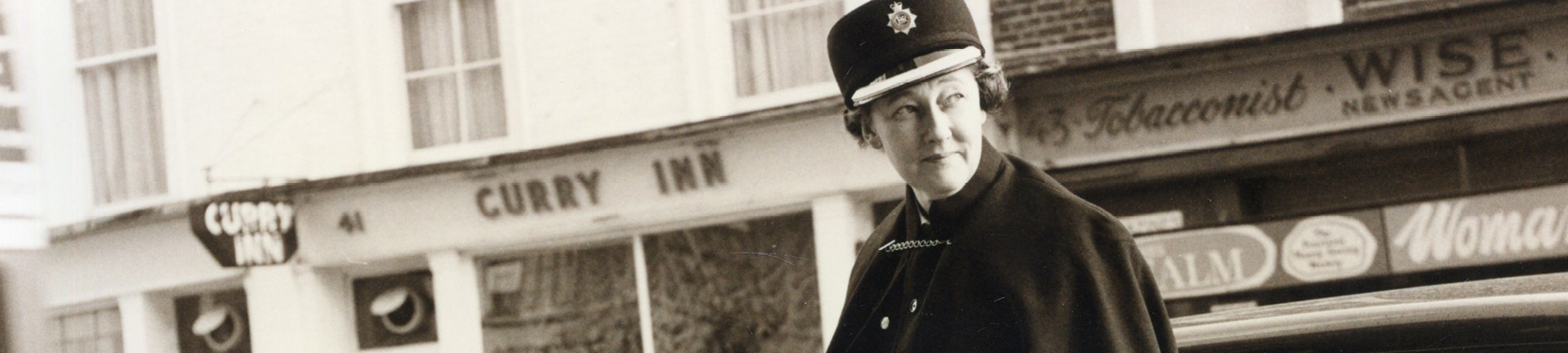
Shirley Becke, OBE, QPM, was a pioneering woman in many ways. After leaving school she became the first woman to qualify as a higher grade gas engineer and as a young woman worked for the Gas Light and Coke company.
During the war she applied to join the Met, imagining she would probably only stay there for the duration of the conflict. She liked the work so much, however, she stayed on. She worked in the CID in one of the Met’s most challenging areas, West End Central, before being promoted to the rank of Sergeant in 1952. She went on to become an Inspector in 1957, then Superintendent in 1960.
Shirley took over leading the women’s police branch at the Met, known as A4, in 1969 and was its last Commander before it was eventually subsumed into the main body of the Met in 1973.
Her promotion to Commander in 1969 meant that Shirley was the first woman in the UK to reach Chief Officer rank and become a member of the Association of Chief Police Officers (ACPO), which represented the most senior officers in the UK. She received the Queen’s Police Medal in 1972 and was made an OBE in 1974.
Throughout her career Shirley was involved in driving recruitment of female police officers and fair representation for women in the police service.
Former ACPO President Sir Hugh Orde said of Shirley: “Her personal story is an inspiration, making it clear women could do the same role as men within the service… Her determination most certainly contributed to the more inclusive police service we see today."
Read more stories
-

DS Charmain Brenyah
Mentor for disadvantaged girls.
-

PC Faye McSweeney
Recruiting the next generation of firearm officers.
-

PC Karen Giles
Met's longest serving female police officer.
-

DCI Lily Benbow
Safeguarding partnership lead, Islington & Camden.
-

Chief Superintendent Sally Benatar
Oversees policing in South West London.
-

PC Sislin Allen
The Met’s first black female police officer.
-

Inspector Lilian Wyles
First female CID officer.
-

Superintendent Sofia Stanley
Leader of the first women patrols.
-

Commissioner Cressida Dick
First female Commissioner of the Met.
-

Join the Met
Find out more about careers in the Met and apply.